





What Is Knee Buckling?
That sudden moment where your knee just… gives. You’re walking normally, or stepping down a stair, and the joint sort of collapses under you. Sometimes it recovers immediately. Sometimes you actually fall.
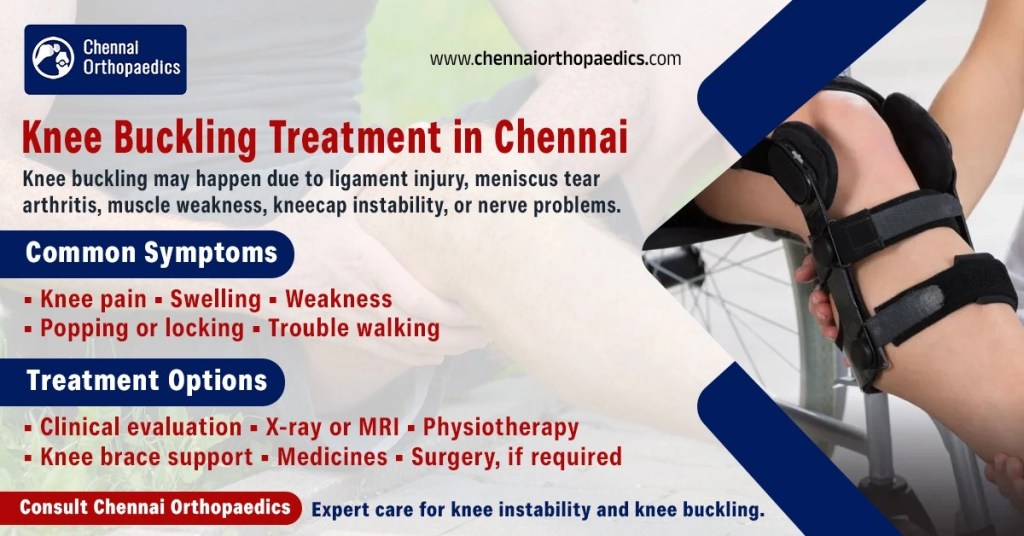
Knee buckling is when the knee gives way, feels unstable, or feels too weak to hold your weight. It might happen once and never again. Or it might keep showing up, which is when it becomes a real problem. Knee instability like this isn’t something to keep brushing off — a knee that feels like it will give out is telling you something’s not right underneath.
Knee Buckling vs Knee Locking
These get mixed up a lot but they’re different things.
Buckling is the knee giving way — it folds or collapses. Locking is when the knee gets stuck and won’t bend or straighten properly. Both are concerning but for different reasons, and they usually point to different causes.
| Problem | Meaning |
| Knee buckling | Knee gives way or feels unstable |
| Knee locking | Knee gets stuck or cannot move normally |
A catching sensation during movement sits somewhere in between — it’s worth mentioning to a doctor either way.
Common Knee Buckling Causes
There isn’t one single reason knees buckle. It could be a ligament, the meniscus, arthritis, the kneecap tracking wrong, weak muscles, nerve issues, or something called plica syndrome. The cause changes the treatment entirely, so figuring out which one applies actually matters.
Ligament Injury
The ACL, MCL, PCL, LCL — these ligaments are what keep the knee from moving in directions it shouldn’t. When one of them tears or gets stretched from a sports injury, fall, or awkward twist, the joint loses that stability. ACL tear and knee buckling often go together. The knee feels like it can’t be trusted, especially during direction changes or uneven ground.
Meniscus Tear
The meniscus acts like a cushion and a stabiliser. When it tears, it can cause pain, swelling, and that catching or locking sensation during squatting, twisting, or regular walking. Knee locking and buckling together — especially if there’s swelling — is a common presentation of meniscus damage.
Arthritis
Osteoarthritis gradually wears away cartilage. As the joint surface deteriorates, the knee becomes painful, stiff, and progressively less stable. Rheumatoid arthritis causes inflammation that weakens the joint differently, but the result can look similar — swelling, stiffness, and a knee that suddenly gives way during normal activity.
Patellar Instability
The kneecap is supposed to glide in a specific groove as the knee moves. When it doesn’t track properly — shifting sideways or sitting unevenly — the knee feels unreliable during movement. Patellar instability and knee buckling often show up together when someone’s kneecap is moving in ways it shouldn’t. Chondromalacia patella, where the cartilage under the kneecap softens, can contribute to this too.
Muscle Weakness
This one gets overlooked. Quadriceps weakness is one of the most common reasons knees buckle, especially going downstairs. The quads control how the knee handles load. When they’re weak, the joint takes more stress than it can manage and starts giving way. Hamstring and glute weakness adds to this — the whole chain of muscles around the knee matters.
Nerve Problems
Femoral neuropathy or nerve damage can reduce the signals that keep muscles working properly. When those signals get disrupted, the knee can buckle without warning — sometimes without pain at all, which makes it confusing. Knee buckling without pain, especially with any numbness or unusual sensations in the leg, is a reason to get a neurological cause ruled out.
Plica Syndrome
The plica is a fold of tissue inside the knee joint. When it gets irritated — from overuse, injury, or repeated movement — it can cause clicking, popping, discomfort, and a feeling of instability. Knee popping and buckling together, with no clear structural injury, sometimes traces back to this.
Symptoms That May Come With Knee Buckling
Buckling doesn’t always arrive alone. Most people also deal with at least a few of these:
- Knee pain
- Knee swelling
- Knee stiffness
- Knee popping
- Locking or catching
- Weakness
- Reduced range of motion
- Fall risk
Some people have knee buckling with swelling and significant pain. Others have buckling without pain, which is actually sometimes harder to figure out — and harder to take seriously until a fall happens.
Why Does My Knee Buckle While Walking or Going Down Stairs?
Stairs put more demand on the knee than flat walking. Going downstairs especially loads the quadriceps heavily and requires the joint to control the descent. If there’s muscle weakness, arthritis, a kneecap tracking issue, or ligament instability stairs expose it. The knee buckles going down stairs because that’s where the weakness can’t hide.
Walking on uneven surfaces does the same thing. The knee gives out while walking more often when there’s less predictable ground to deal with, because the joint has to make small adjustments constantly and can’t.
Is Knee Buckling Serious?
One random episode after a long walk? Probably not alarming. But repeated buckling, or buckling that comes with other symptoms, is a different situation.
See a doctor if you have:
- Repeated knee buckling
- Knee buckling after injury
- Swelling or severe pain
- Knee locking
- Trouble walking
- Frequent falls
- Numbness or weakness
Sudden knee buckling after a sports injury or fall needs prompt evaluation. Waiting tends to make the underlying cause harder to treat.
How Knee Buckling Is Diagnosed
The doctor starts with questions — when does it happen, how long has it been going on, any recent injury then moves to a physical exam. They’ll test range of motion, check how the kneecap tracks, and do specific ligament tests that can reveal instability without imaging.
From there, a knee X-ray can show bone structure and joint spacing. Knee MRI is more useful for soft tissue ligament tears, meniscus damage, cartilage problems. If nerve damage is suspected, additional testing may be needed. An orthopedic specialist puts the clinical exam and imaging together to get the full picture.
Knee Buckling Treatment
Treatment follows the cause. There’s no point wearing a brace if the problem is a ligament tear that needs repair. And there’s no point jumping to surgery when weak quadriceps are the whole issue.
| Treatment | Best For |
| RICE method | Mild pain or swelling |
| Physical therapy | Weakness and instability |
| Knee brace | Temporary support |
| Cane support | Fall risk |
| Medical treatment | Injury, arthritis, or severe symptoms |
Mild cases — especially those driven by muscle weakness or early arthritis — often respond well to physical therapy and targeted strengthening. More significant causes like ligament tears, meniscus damage, or advanced joint disease need medical management beyond what rest and exercises alone can fix.
Should You Use a Knee Brace for Knee Buckling?
A knee brace helps in the short term. It gives the joint some external support and can reduce the immediate fall risk while you’re getting things evaluated or going through rehab. That’s genuinely useful.
But a brace doesn’t fix the reason the knee is buckling. It’s support, not treatment. If knee instability keeps happening and a brace is the only thing being used — the underlying cause is still there, just temporarily propped up. Frequent or recurring buckling needs a proper diagnosis, not just a brace and hope.
Expert Knee Buckling Care at Chennai Orthopaedics
Knee buckling can make the knee feel weak, unstable, or as if it may suddenly give way while walking, standing, or using stairs. At Chennai Orthopaedics, Dr. Bharani Kumar provides expert evaluation to identify the cause of knee instability — whether it’s related to ligament injury, meniscus tear, arthritis, muscle weakness, or kneecap tracking problems — and recommends the right treatment plan based on each patient’s condition.
Frequently Asked Questions About Knee Buckling
Why does my knee buckle when I walk?
Usually muscle weakness, ligament instability, arthritis, or kneecap tracking issues. Walking exposes any of these when the knee has to handle repeated load. Worth getting checked if it keeps happening.
Why does my knee give out without pain?
Nerve-related causes — like femoral neuropathy — can reduce muscle control without causing obvious pain. The knee gives way because the muscles aren’t getting proper signals. Knee buckling without pain alongside numbness or weakness should be evaluated promptly.
Can arthritis cause knee buckling?
Yes. Both osteoarthritis and rheumatoid arthritis weaken and destabilise the joint over time. Pain, stiffness, and swelling from arthritis all contribute to the knee feeling like it might give way.
Can a meniscus tear cause knee buckling?
It can. A torn meniscus disrupts the mechanical function of the joint. Knee locking and buckling together, especially after twisting movements, is a common pattern with meniscus damage.
Is knee buckling a sign of an ACL tear?
It can be. ACL tear and knee buckling is a classic combination, especially after a sports injury or fall. The knee feels unreliable and may give way during direction changes or uneven ground.
What is the difference between knee buckling and knee locking?
Buckling — the knee gives way or collapses. Locking — the knee gets stuck and can’t move through its normal range. Both need attention but usually have different causes.
Can weak thigh muscles cause knee buckling?
Yes, and this is more common than people expect. Quadriceps weakness means the knee can’t control load properly. Strengthening the quads — and the surrounding muscles — often significantly reduces buckling in cases where weakness is the main driver.
Should I wear a knee brace for buckling?
A brace can help short-term with stability and fall prevention. But it doesn’t treat the cause. If buckling is recurring, get a diagnosis alongside using the brace.
When should I see a doctor for knee buckling?
Repeated episodes, buckling after an injury, swelling, locking, trouble walking, or any falls caused by the knee giving out — all of those are reasons to get seen rather than wait.
Authored by Dr Bharani Kumar Dayanandam, MBBS, Orthopaedic Surgeon