




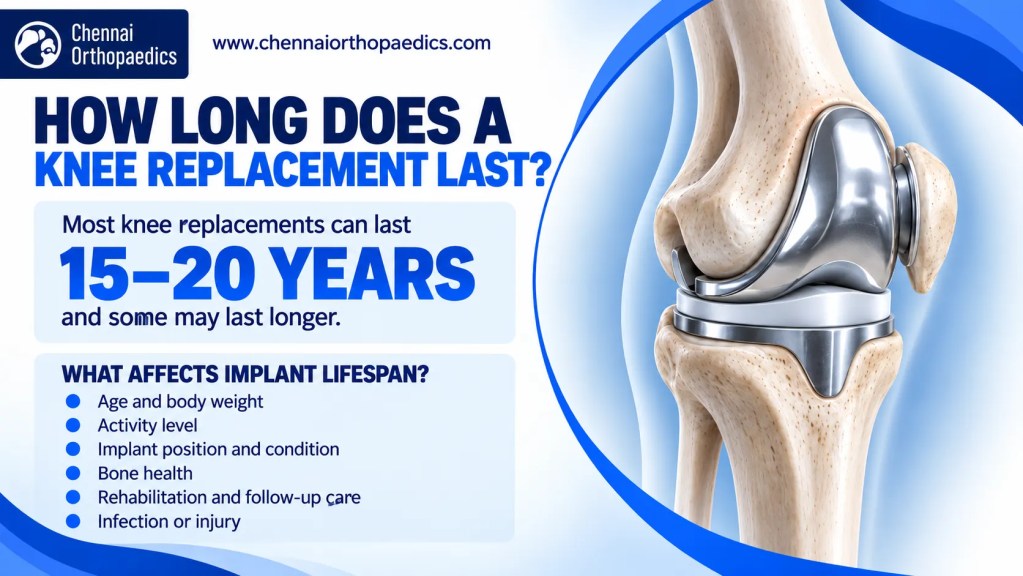
Fifteen to twenty years. That’s the figure most surgeons will give you if you ask them directly, and it’s a fair one though plenty of implants quietly outlast it, sometimes running 20, 25 years or more without issue. There isn’t a fixed shelf life stamped on the thing. What you actually get depends on your age, your weight, how hard you use the joint, how well it was positioned in surgery, and, frankly, how seriously you take the recovery afterward.
What Is the Average Lifespan of a Knee Replacement?
The 15–20-year number comes from population data studies tracking large groups of patients over time not from any promise made about your specific knee. It’s worth treating it as a planning figure rather than a countdown clock. Plenty of people are still walking around comfortably on implants well past the two-decade mark. When orthopaedic surgeons talk about longevity, what they mean is how long the joint keeps functioning before it needs revision surgery. Nobody can hand you an exact date. What they can offer is a range built from people whose situations looked something like yours.
What Factors Affect How Long a Knee Replacement Lasts?
Age is a bigger factor than most people expect someone who gets a replacement at 50 is, statistically, more likely to need a second procedure down the line simply because they’ll be putting decades more wear on it than someone who has the surgery at 75. Weight matters too, for the obvious reason: more load on the joint every single day adds up. Then there’s activity level. Running and jumping put a different kind of stress on an implant than walking does, and that difference compounds over years.
Beyond lifestyle, there’s the surgery itself. How precisely the implant was aligned during the operation has a real, lasting effect on how the joint moves and how evenly it wears. The materials and design of the implant play a role as well not all components are built the same. Your underlying bone health matters, along with any other conditions you’re managing and your baseline infection risk. And rehab isn’t optional in this picture; skipping physiotherapy or doing it half-heartedly tends to show up later as reduced strength and mobility. Injury or infection, if either happens, can also damage the joint or loosen the implant outright.
How Can You Help a Knee Replacement Last Longer?
A decent chunk of this is within your control. Keeping your weight down takes real, measurable pressure off the joint over time. Sticking with physiotherapy genuinely sticking with it, not just for the first few weeks pays off more than people assume. You don’t need to give up being active either; walking, swimming, and cycling are generally fine and even encouraged, it’s the high-impact stuff (think repeated running or jumping) that’s worth avoiding unless your surgeon has explicitly said otherwise. Watch your footing to avoid falls, don’t skip your follow-up appointments even when everything feels fine, and if something new shows up pain, swelling, a sense that the knee isn’t quite right say something early instead of waiting to see if it passes. None of this guarantees a set number of years. It just tilts the odds in your favor.
What Are the Signs of a Worn or Loose Knee Replacement?
A few signs are worth taking seriously: pain that’s new or getting worse, swelling that won’t settle down, stiffness that keeps creeping up, a feeling that the knee might buckle or give way, a noticeable loss of range of motion, or walking becoming harder than it used to be. None of these automatically mean the implant has failed, though — infection, a separate injury, or another knee issue entirely can look almost identical from the inside. The only real way to know is an orthopaedic exam, usually paired with imaging.
Can a Knee Replacement Be Replaced Again?
Yes, and it happens more often than people assume. When an implant wears out, loosens, or gets damaged, surgeons can go back in and perform what’s called revision knee replacement removing and replacing some or all of the original components. It tends to be a more complicated operation than the first one was, simply because there’s more scar tissue and altered bone to work around. Whether it’s actually needed comes down to your symptoms, what the imaging shows, the state of your bone, whether infection is a factor, and your overall health at the time.
Conclusion
Fifteen to twenty years is the realistic middle ground, with plenty of people landing well beyond it. Where you personally end up depends on a combination of things some in your control, some not. If new pain, swelling, or instability shows up, don’t sit on it. Getting it looked at by an orthopaedic specialist early is generally the difference between a quick fix and a bigger problem later.
Leave a Reply